Friday, July 16, 2010

Mainly Maine, Part 5: Transgendered Shrimp

One Maine food bombshell for me was that Maine had good shrimp. American markets have been so innundated with cheap Thai shrimp that we forget there are good native varieties. I grew up with Gulf shrimp, but the of-Mexico variety; there is a Gulf of Maine kind, too, whose season begins in December.  Maine shrimp are small, but tasty, with a delicate, almost sweet taste. Great for a milk-based chowder.  Here I am sauteing some whole, unpeeled, early-season ones that we got at a local seafood vendor for $3/lb on December 9:


I mention the date, because here are some raw ones I got almost 3 weeks later, on December 29, for only $1/lb.  Aside from the price, note the difference.

That blueish stuff you see on the later shrimp is roe. It's mild tasting (not strong and salty like most fish roe), translucent powder blue, and if I could harvest enough, I'm sure I could sell it in Boston or NYC as a gourmet cracker-and-cream cheese item for $100/lb--hey, it was not easy wrestling all those blue eggs from those shrimp legs.  As it was, I made some shrimp chowder (no photo) and used the roe for a garnish. I used lobster bodies and the shrimp shells for the chowder stock.
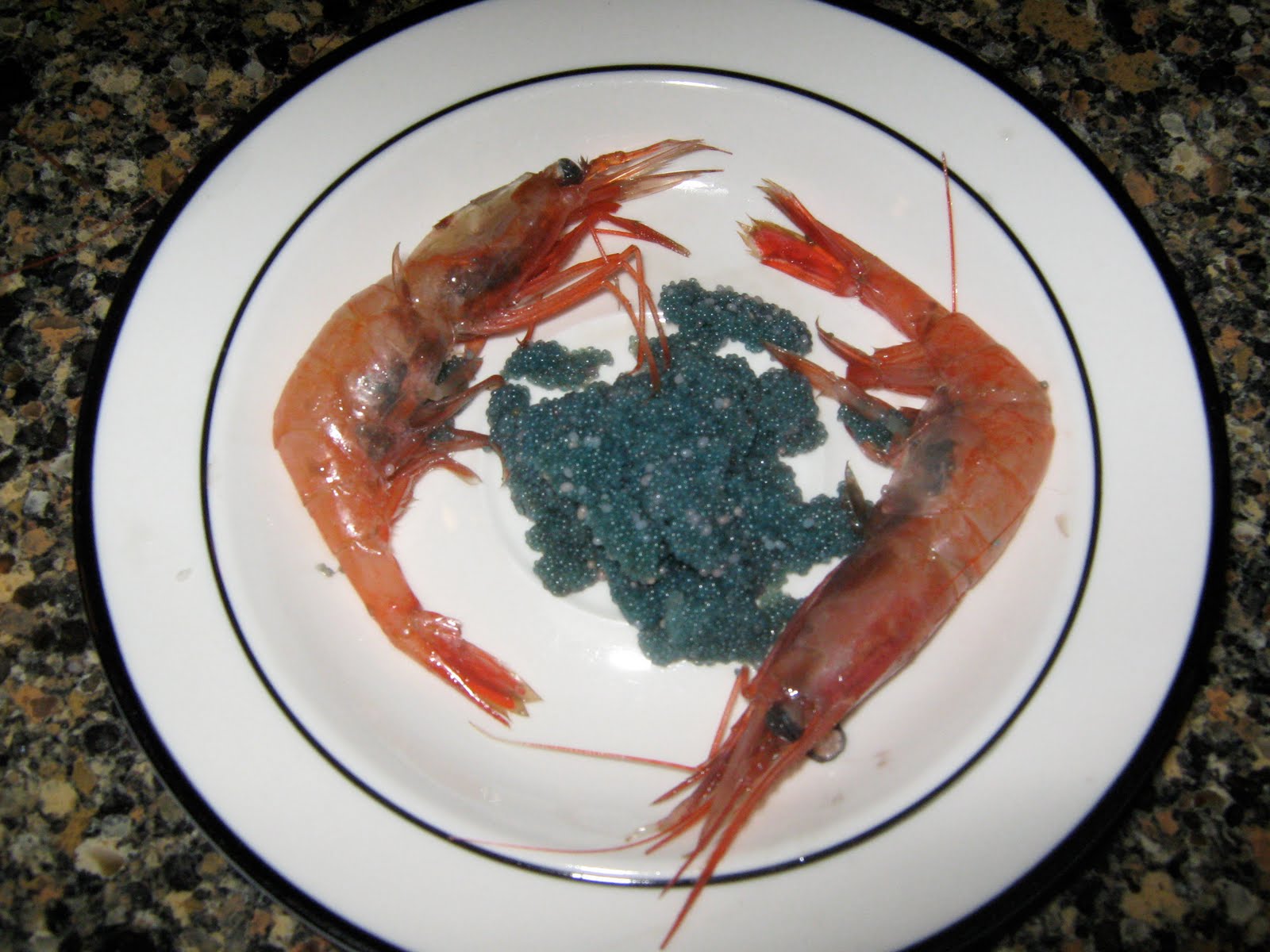

Here's the odd part: NEARLY EVERY SHRIMP IN THIS BATCH HAD ROE IN IT. The first batch 3 weeks earlier was roe free. This raised a lot of quesions. Were these all female shrimp or do males carry eggs, too, like seahorses? Did all the males go south for the winter after mating (men!).  Are Maine shrimp bisexual or hermophroditic?  Did this have anything to do with the Maine legislature voting down the gay marriage bill three months ago?

Here's what some brief research revealed: Northern Shrimp, Pandalus borealis, occur in the U.S. only in the Gulf of Maine. They begin their lives as males and switch to females about halfway through their 4-year life span. Note that in this shrimp tribe, it's always the older females spawning with younger males. In humans such older females would be called Cougars; in the shrimp world, they're called smart--younger males to spawn with, i.e., better broods.

Exactly how this gender switch takes place was not explained clearly--Wikipedia says magically "their testicles turn to ovaries"--but there's a moral here: when you study the real Mutual of Omaha's Wild Kingdom carefully, you discover some really wild stuff, and it ain't all grizzly bears and wolf pups.

So, the now transgendered M2Fs with their new reproductive capabilities come in from the cold water toward the shores to spawn in the winter, and that's where most of the commercial shrimping takes place. In other words, these were indeed all females in their new responsibility to produce shrimplings for the kindergarten at the end of the spring thaw. Perhaps the few roeless ones in this batch were some sympathetic males still waiting for their operations but wanting to swim with the girls. Personally, I feel awful about contributing to the end of so many future shrimp boys-who-become-girls, but I chowdered forward. Merci, mon crevettes.

Mainly Food, Part 4: Some fish have shells

I had no intention of going to Maine and not sampling local foods, whatever that turned out to be. You won't be surprised that it included lobster.

Maine's summer is short, so there is no Portland Tomato or Eastport Pepper. There are Maine potatoes, blueberries, and maple syrup. And you can fish most of the year for something, so chowders are staples.  They're everywhere, like in a diner in the small town of Bowdoinham:


What kind of fish was in the chowdah was a mystery, but you can bet it had potatoes and milk as a base.


In fact making chowder at home is pretty easy when you have access to the following stuff--"fish parts 29¢/lb", "lobster bodies $1.50/bag"--sold in many seafood markets. I made a nice lobster stock for later:


The big deal here is the so-called lobster roll. It's basically lobster meat usually with mayo (alternately butter) on a soft hotdoggish roll. Lobster roll aficianodos argue whether a leaf of lettuce should go on the roll, but the anti-lettuce people tend to prevail. It's mostly a summer treat, an in-hand sandwich for warm-weather coastal slumming. If the lobster is fresh, it's wonderful.  In my limited experience so far, most places use all claw meat, like the  one below (which cost $12.95). 


When I asked about it, their argument to me was that the claw meat is sweeter, and the red color is more visually appealing.  Personally, I think it's because the claw meat is cheaper, so the profit margin is higher--tails get shipped to out-of-state markets, claws get put on lobster rolls. Ka-ching.

(Important Note: Lobster tails are technically not tails, but thoraxes, but they would never be called that because it's a dreadful word with no sex appeal, and it sounds like an animal from a Dr. Seuss story. Compare: "I'm eating some tail tonight" vs "I'm eating some thorax tonight."  Hmm?)

I visited Eastport for a few days, and I wanted to try something other than lobster while I was there, but lobster was about all that was safe to eat. This sign on a telephone pole near the water tells the tale:


Such paralytic poisons, caused by what are known as "red tides", are not killed by cooking, have no taste, and can paralyze your breathing in 2 hours. You'd basically become the steamed clam you ate. I happily munched on lobster tails, pondered the possible taste of a carnivorous whelk, and wondered whether the snails were also meat eaters. This made me rethink the slugs in my garden back home. I would have to wait for another trip for a comparison of clam chowdah DownEast. Or whatever else was available. Next, more fish tails/tales.

Saturday, June 12, 2010

Berry good season

Cliched title, but given the abundance of the season, I couldn't help it. One good thing about the small town I live in is that there are many places to get very fresh fruits directly from the farmers and orcharists.


One of last remaining large farm families here in Berkeley County West Virginia, the Orr family, has managed to thrive. One thing they do that endears them to the locals is their pick-your-own fruit seasons. First come strawberries, then cherries, then raspberries and blueberries.

The strawberries fields were ready
toward the end of May. 


My brother and I went a-pickin for an hour or so, and got enough for us to munch on fresh, but I'm a very discriminating picker. I would starve as a field hand picking 4 quarts/hour.


I ate some, froze some, and brought some to New York as a house gift to a friend who was putting a couple of us up for a few days while we attended the Book Expo.


What could be a better gift than 2 quarts of fresh strawberries picked the day before?

I did hold out the most interesting berries for myself.  The best thing about real food is that it doesn't come in easily packable and shippable shapes.


Tuesday, May 11, 2010

Maine-ly Food, Part 3: Oyster/Erster

While the winter isn't necessarily colder on the coast of Maine than it is in, say, West Virginia (where I reside now), it is longer. You begin to understand clearly why fish and shellfish are so important to the diet of Mainers: it's what you can catch and eat when all else dies.

While coastal Maine has some predictable sea life and sea food, there were some sea-prises for me, and oysters were one of them; I never clearly associated Maine with them.

Many years ago, I had had some very tasty "Glidden Point" oysters once at a restaurant in DC when I lived there, but I didn't know that Glidden Point was in Maine. In fact, it's a point along the Damariscotta River, where the most well-known Maine oysters live and breed. Oysters are common in New Orleans (where they're pronounced like 'ersters') so ordering them in Maine felt like I was home.

My friend Howard and I drove to the town of Damariscotta to see if we could sample a few local raw ones. We stopped at a pub on the main street where they served Daramiscotta oysters all year round. They were not cheap at $2.50 each, but we were there to test the waters. We each slurped 3 and proclaimed them large, plump, and succulent, but very briny. Except for the expense, I might have turned them into oyster stew. I remember the Glidden Points as less salty, perhaps because they're harvested more inland.


In fact, one of the big seafood markets in Portland had a variety of Maine oysters, as well as clams and mussels, so there are many more two-shelled critters to sample. I saw a bivalve chowdah in my future:


For comparison, we went to Portland, and ate at J's Oyster Bar on the waterfront, where we tried some oysters which the waitress said were from the Johns River. There were a lightly-briny oyster, more like the Glidden Points I remembered.


But frankly, except for size and brininess, it's hard for me to tell one oyster from another, unless I could somehow get samples from different waters to compare at the same sitting, and even here, I suspect that the taste will vary from season to season.

On a subsequent trip to Portland, we ate at The Farmers Table, where local catches are standard fare. There we had Maine rock crab cakes with homemade herbed mayo, local bread, and local mussels steamed in local beer.


"Local beer? Howard, you didn't tell me there was local beer." We went to the oldest brewpub in Portland, Gritty McDuff's (old here is 1988) and had their Black Fly Stout. Members of the beer club have their own steins all over the walls, ready to be taken down and filled whenever they come in.


I wish oysters and stout went together. Actually, I didn't think the McDuff's-beer steamed mussels at the Farmers Table were an ideal combination. Next time maybe I'll suggest some local Chardonnay from Bar Harbor Winery.


Maine-ly Food, Part 2: Red Lobsters and Red Tides

While Maine has a big variety of seafood, on my first trip there, I wanted to try what they're famous for to see if it was worth all the blather. I have attempted steaming lobsters that I've bought from my local supermarket in West Virginia, but I think that lobsters are essentially unhappy in the mountains, and thus refused to cook properly out of protest.

So the big deal to me on my virgin launch to Maine was having a steamed lobster. My friend Mary Jane had waited for me to come to Eastport for a lobster dinner since she knew I was anxious for the true Maine culinary experience.
We went to the Seaview campground north of the town (actually there is no "south of town" since Eastport is at the end of a peninsula/island, so if someone tries to send you south of town, they're either not local, or they're locals up to no good), an unlikely place for a steamed lobster I thought; on the camp site was an unassuming restaurant for the campers, who got a deal on dinners. Note that behind the bar in the restaurant is a sign that says Bourbon Street. As possibly the only New Orleanian in Eastport, I felt welcomed.


Mary Jane wanted the biggest lobsters they had (it was her birthday), but on this day the best they could do were three lobsters at 2.2 pounds each. Steamed and served with a pound of melted butter, it was simple but sumptuous. MJ was impressed with my lobster dismantling skills, which included all the meat in the head. Having grown up in New Orleans, my crab picking was pretty honed; lobster heads are very like crab bodies.


I wanted to try some other seafood, but lobster was about all that was safe to eat. This sign on a telephone pole near the water tells the tale:


Such paralytic poisons, caused by what are known as "red tides", are not killed by cooking, have no taste, and can paralyze your breathing in 2 hours. You'd basically become the steamed clam you ate. I happily munched on lobster tails, pondered how a carnivorous whelk tasted, and wondered whether some snails were also meat eaters. This made me rethink the slugs in my garden back home. I only spent a couple of days in Eastport, so I would have to wait for another trip for a comparison of clam chowdah DownEast. Or whatever else was not paralytic. In Part III, more fish tails/tales.

Maine-ly Food, Part I: What's for dinnah?

I have a new friend, Howard Solomon, in Bowdoinham Maine and have visited him a number of times over the last year. While the coast is beautiful and the small towns are picturesque, I had no intention of visiting Maine and not sampling local foods, whatever that turned out to be. You won't be surprised that it included lobster. But Maine's seafood stock (pun intended) is loaded with more than lobstah.

Maine's summer is short, so there is no Portland Tomato or Eastport Pepper. There are Maine potatoes, blueberries, and maple syrup. And you can fish most of the year for something, so chowders are staples. So is its pronunciation, as you see by this sign in Bowdoinham:


What kind of fish was in the chowdah was a mystery, but you can bet it had potatoes and milk as a base. In fact, making chowder at home is pretty easy when you have access to the following stuff--"fish parts 29¢/lb", "lobster bodies $1.50/bag"--sold in many seafood markets. I made a nice lobster stock for later:


This specials board from a Portland diner was a delight, with a lot of local catches-of-the-day: haddock baked and chowdered, local Jewell Island scallops, crabcakes, and steamed lobster. I assume that the nachos listed first would be a welcome change in Maine from all that boring, ordinary lobster. (Note to my New Orleans connections: shellfish are never ever boiled like they are in Louisiana; they're always steamed. And neither is anything herbed or spiced.)


The big deal here is the so-called lobster roll. It's basically lobster meat usually with mayo (alternately butter) on a soft hotdoggish roll. Lobster roll aficianodos argue whether a leaf of lettuce should go on the roll, but the anti-lettuce people tend to prevail. It's mostly a summer treat, an in-hand sandwich for warm-weather coastal slumming. If the lobster is fresh, it's wonderful. In my limited experience so far, most places use all claw meat, like the first one below from this diner (which cost $12.95). When I asked about it, their argument to me was that the claw meat is sweeter, and the red color is more visually appealing. Personally, I think it's because the claw meat is cheaper, so the profit margin is higher--tails get shipped to out-of-state markets, claws get put on lobster rolls. Ka-ching.


(Important Note: Lobster tails are technically not tails, but thoraxes, but they would never be called that because it's a dreadful word with no sex appeal, and it sounds like an animal from a Dr. Seuss story. Compare: "I'm eating some tail tonight" vs "I'm eating some thorax tonight." Hmm?)

But in Eastport, my friend there, Mary Jane, took me to a seafood shack that she swore made the best lobster rolls (which cost $13.95). You could watch them haul the lobsters in. I had one there that was mostly "tail" meat, garnished with a hunk of whole claw meat. In addition to mayo and butter, they also offered the option of miracle whip, I suppose for those watching their waistlines. In which case, I'd suggest they forego the chips and the sloppy slaw. I vote it the best I've tasted so far (which includes 4 different ones). The lobster guy wasn't bad, either.


Saturday, July 11, 2009

Vegetable Kids

“Where is my neighbor that I can eat his garden?”—a question that my neighbor Nicole said her son Dylan asked her one day. Nicole and Ryan Teasley have been my neighbors for years, and I watched Dylan and Gracie grow up. Now the kids are learning to ride bikes.

The Teasleys are vegetarians, and their two kids are happier than most to eat their vegetables. Earlier in the year they had nibbled the mesclun I had in large pots, including the arugula. They were over one day recently, and as I was talking to their parents about the various herbs I have in my garden, the kids got interested in trying them. They tasted the tarragon, the rosemary, the lovage, the thyme--even the flowers of the bergamot or bee balm.

Their interest in and positive response to fresh herbs and odd salad possibilities was a good lesson that what we think of as standard children’s food prejudices isn’t a standard. Not all kids crave bologna sandwiches, or mac and cheese, although Gracie and Dylan certainly like mac and cheese.

They’re very healthy kids, so it’s also clear that meat protein is not a requirement for health. Nicole and Ryan note that they eat soy "meats" and beans for their protein. Dillon, especially, likes raw foods and is a salad fanatic.

What a pleasure to have two young children in my garden wanting to try the edible greenery. For a foodie like myself, it’s a refreshing contrast to so many local kids who wouldn’t eat anything but hot dogs and iceberg lettuce.

For an instant, as I watched them pinch off a leaf of tarragon and tell me it tastes like black licorice, I felt like maybe the next generation, whatever they call themselves, might just make this country a better place. Foodwise, at least.

Thanks, Gracie. Thanks, Dylan. You made my tarragon smile.

Sunday, June 28, 2009

Your Grandma's Pot


Everybody has their favorite kitchen object. I got an old round cast-iron griddle at a flea market many years ago that is perhaps my favorite piece of cooking equipment. It fits perfectly on one burner, and it allows me to cook more than one thing at a time--eggs, potatoes, and shrimp for breakfast; grilled cheese and sliced zucchini for lunch. I use it a lot.


A friend of mine, Ted Mann in Arlington Virginia, is always looking for antique kitchen stuff at flea markets and church bazaars and giving them to me. He’s obsessed with old kitchen equipment, and I sometimes get the benefit of his obsession.

He found a few things for me last year that are some of my favorite items: French steel sauté pans and a 14” oval copper-bottomed sauté pan, presumably for fish, for $10. The latter has that wonderful, hammered finish that you don’t see in modern versions.


Ted also has some nice old appliances. One is an old toaster that looks vaguely Art Deco or perhaps Mission inspired, but it is small, and recently we had a good laugh trying to toast some large Tuscan bread slices in it. We just had to do a turn-and-toast a couple of times.

Ted’s found me a couple of beautiful antique tools, like this whisk, which I have hanging up.

Recently, he got a whole box of cookware, including a set of 1960s Magnalite cookware for a few bucks. This was the earliest aluminum cookware for the home, and it's still some of the best.

Like all old things, old pots, pans, and whisks have stories, and you wish they could talk about them: the kid who set off the fire alarm because he buttered the bread before he put it in the toaster, or the grandmother who used the whisk to make a cake for her husband not long before he died, or the carving knife that sliced a turkey on that lonely Christmas during WWII.

I don’t know my griddle's or my pans' stories but I connect to them anyway. I know that my old tools have a culinary history and that someone somewhere was comforted by what they cooked with them.

And I continue the tradition, and the stories. Except the part about buttering the bread before it goes into the toaster.

Tuesday, May 12, 2009

The Best Gumbo Ever

I’ve had stuff in my freezer for months waiting to go into my next big pot of badass gumbo, and finally I decided to clean out the freezer and do it—leftover turkey from Thanksgiving, turkey stock (I thought), shrimp, sausage, and a couple of squirrels from Terry my neighbor (the same one who gave me the trout in an earlier posting).

The squirrels were the wild card here—new for me—but sheesh, they more or less have parts like a chicken, right, except for arms where wings would be? And except for the fact that they kind of look vaguely fetus-like...


I started out with what now has become a normal gumbo beginning—first you make a roux.
(Traditionally gumbo could be thickened with roux, or okra, or filé powder, but not all three. Today, roux-based gumbos are common, with okra thrown in, and filé as a kind of condiment seasoning at the end.)

A gumbo roux is dark, and it’s easy to burn, so I keep the fire low. I used 10 tablespoons each of olive oil and flour. It takes two hours for me to produce a good roux on low heat, but at least I don’t ruin it. Here's the roux at the beginning


and the end of the two hours.


Then into the roux went 4 cups of chopped onion, bell pepper, and celery, and that cooked for 10 minutes.

Then in went what I thought was frozen turkey stock—except that it wasn’t. It was another roux + vegetables gumbo base that I had frozen for a quick start next time. So now I had a gumbo base cooking that was as thick as paste. I had to thin it out with lots more canned stock and chopped tomatoes (and a bottle of beer), which gave me a lot of liquid to work with. This was going to be a big pot o' gumbo, really big.


All I could do is try to fill the void with whatever I had--in this case, two pounds of smoked sausage, two pounds of shrimp, two squirrels, 8 cups of chopped turkey. In case it wasn’t enough, I took out the fryer I had and began to thaw that.

The shrimp I boiled for 5 minutes, cut each in half horizontally (to allow more shrimp pieces to permeate the soup), and boiled the shrimp water down to concentrate the flavor before putting it in the gumbo.

A classic formula for gumbo has a trio of meats: a red meat, a fowl, and a fish or shellfish. The squirrel was an odd West Virginia touch—Creole meets Mountaineer.

I had no experience with squirrel, so I tried first just cooking the whole squirrels in the gumbo liquid for 30 minutes and then trying to cut them up. I wasn’t very efficient, so I put all the mutilated parts into a strainer and continued to cook the squirrel in the gumbo. Twenty minutes later, they were still tough, so I took the parts out and braised them in a separate pot with some wine. The meat is very lean, but not at all gamey.


The whole process took most of Mother’s Day, but since my recently deceased mother was a great cook, she would have been right there with me. And she was. OK, except that mother only made seafood gumbo, with shrimp, crabs, and oysters, and she might have winced at the squirrel carcasses.

I like serving gumbo with the rice on top for color contrast, garnished with chopped parsley and green onions. And in this case, a bit of braised squirrel in the bowl.

Happy mother’s day, mother. Except for the sausage, turkey, and squirrel, my gumbo is your gumbo.

Thursday, May 7, 2009

Pineapple Palate

I really love fresh pineapple, but whenever it’s served in restaurants or on buffets, it’s either canned or never ripe enough. To get really good, sweet pineapple—assuming you don’t live in a pineapple growing region—you have to let it ripen at home past the point you think is long enough. Most information about pineapples say that they do not get sweeter as they ripen off the stalk.

That has not been my experience. But to get the best taste, I’ve found that there should be no green anywhere on the fruit. Yellows and browns and oranges are the right, ripe colors. It can take two weeks after I bring a pineapple home before I cut it, because most supermarkets sell green fruit, not bush-ripened fruit.

The first picture is a pineapple I bought a couple of days ago. It’s mostly green with a bit of yellow toward the bottom. Buy a pineapple with some color at the bottom and it will ripen better than a completely green one. Still, if I tried to eat it now, it would be hard and too acidic—and frankly, flavorless.
The next picture is of a pineapple I’ve had sitting around for over 2 weeks. There is no green left at all. It had a very strong pineapple aroma. You have to be careful it doesn’t overripen, but if it does, just cut out any brown areas you see after you cut it, and it’s fine.

It ripens from bottom to top, so the bottom of the pineapple will always be sweeter than the top. Some websites say to ripen a pineapple upside down so the sugars get more distributed. I don’t know if this is true, but it can’t hurt, assuming you can find a place to hang or stand it upside down.

You can cut a fresh, ripe pineapple into slices and then peel and core them, or peel it first and then slice and core. Grill some slices with a bit of honey and bbq sauce and it’s a wonderful accompaniment to barbequed pork or chicken.


Warning: Pineapple contains a protein enzyme, which means it can be used to tenderize meat, but some people are also sensitive to fresh pineapple’s enzymes. My friend Mark says that if he eats fresh pineapple, his mouth and throat swell. If you cook pineapple, it eliminates the problem.

I’m glad my palate is pineapple friendly.